
Uncanny Valley
somehow feels different....
On the surface, it all feels like more of the same, attacks and counter strikes, threats and TACOs, yet over the past few days there has been a growing sense that something has changed compared to what we have seen over the last few months. The market, of course, believes this is simply another replay of the first phase of hostilities, and it already knows how that story ended hence oil trades comfortably around $85/bbl. But perhaps there is something we are still overlooking, because while the situation feels familiar, it’s not quite the same drill..
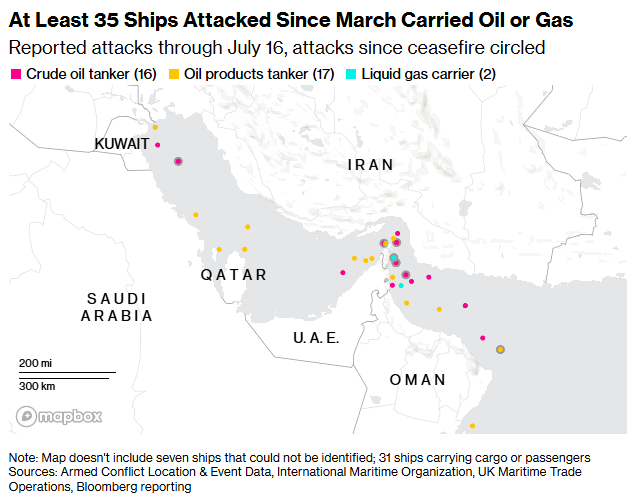
From a military standpoint, the ceasefire is clearly dead, but neither are we in a full scale war. That alone raises questions about the rules of engagement on both sides, if there are any rules left… this is the difference.
During Phase 1, the period before the MoU, despite all that was happening, the Iranian attacks were somehow coordinated, measured, or at least there was some kind of method behind them:
Only target vessels in ballast.
Aim at the engine room or the rudder, avoiding, whenever possible, vessels linked to allies such as Russia, China, and to some extent India.
As for energy infrastructure, strikes were largely limited to peripheral facilities or components, they made great headlines for the doomsayers, but in fact, virtually all targeted refineries and oil fields are already back in operation.
This is mainly what changed this week. There no longer appears to be any tactical logic or restraint.
On Monday, two VLCCs operating UAE’s shuttle service between offshore islands inside the Gulf and Fujairah were attacked, one of them belonging to the ever present Sinokor, arguably one of the companies most instrumental in pushing UAE exports to record highs last month. The market consensus had always been that these vessels were “off limits”, supposedly protected under an understanding with the IRGC, (reportedly linked to the release of the $3 billion). Then came the attack on a fully laden chemical tanker operating nowhere near the Strait … two Indian seafarers dead, now add the Houthis, that were also paid off… This is looking like a rogue unit within a rogue actor within a rogue state rather than a strategy, adding yet another layer of unpredictability to an already unstable situation.
To make things worse, the US is not staying behind either, they struck an Iranian VLCC near Kharg Island, reinstated a blockade and then there is Ukraine (EU or whoever is behind these days) continues targeting vessels in the Caspian Sea and recently hit an Exxon chartered Suezmax in the Black Sea.
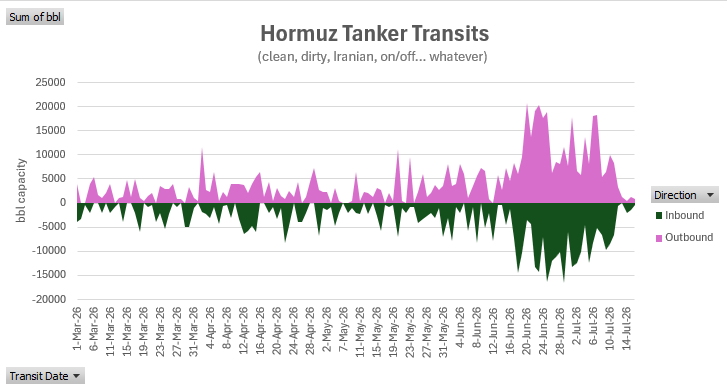
Risk perception has unquestionably deteriorated, particularly among shipowners, who remain the most exposed participants in the supply chain. Tanker transits through the Strait have almost come to a standstill since Tuesday, with only a handful of smaller vessels making the passage. Saudi Arabia, Iraq, and Kuwait continued loading cargoes throughout the week, albeit at a trickle, but these were almost entirely vessels that had entered the Gulf before Monday’s attacks, including the Sinokor fleet. So far there has been no confirmed dark outbound transit since Monday’s incident for VLCCs.
Last week, visible exports through the Strait averaged by all metrics ~5Mnbpd. Today that figure is probably below 1Mnbpd but the market nevertheless expects that, provided there are no further attacks over the coming days, flows will gradually recover toward the 5Mnbpd mark. There is, however, one important difference this time around, you see, the cargoes that remained stranded since March had all been sold months earlier on an FOB basis, meaning ownership and risk is transferred to the buyer at the loading terminal (technically at the ship’s hose manifold for oil people) but since exports resumed, however, most new cargoes have been sold on a DES (delivery ex-ship), DAP (delivery at port), or FOB Fujairah/Sohar basis. In other words, the responsibility for getting the cargo safely across the Strait now rests with the exporter/producer. Previously, a closure of the Strait was legally the buyer’s problem. Now it has become the seller’s responsibility and duty, and we have already seen the first cases of non-performance in the Gulf of Oman. That fundamentally changes the incentives, it’s play or pay, so they must find some workarounds.
My guess is that over the coming days Iran will temporarily step back, because deep down I think they realize they have overplayed their hand this time, they alienated India, Pakistan and to some degree China, the few remaining buyers willing to engage with them. At the same time, escalating the conflict also plays into Trump’s hands by giving him an opportunity to draw more countries into the conflict, not what Iran needs precisely.
Paradoxically, all of this is happening while the most rogue actor of them all, Israel, has remained relatively quiet, so, that naturally raises the question, why now, why these ships?
This is a war of attrition, everyone involved is showing signs of fatigue (ourselves included) while feeling their leverage they think they have is slipping away. Iran understands it cannot push too far because a Strait without traffic has no strategic value, we saw some of that this week with the PM tweet and also the clock toward the US midterms keeps ticking, and for Ukraine… well, as long as the attention remains elsewhere anything is possible, even if it means sending crack spreads to record highs.
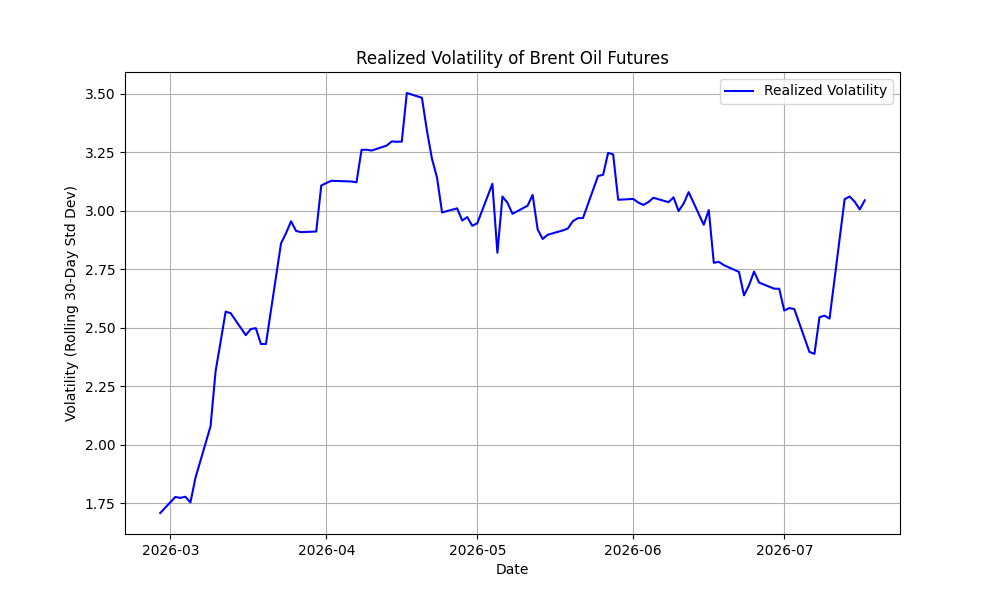
For oil, this is yet another layer of volatility on top of an already high volatility regime. Rather than trying to chase every peak and valley in the flat price, perhaps the better opportunity is to focus on the peaks and valleys in volatility itself.